
Highland Resident Lookup Record Map
San Bernardino County holds most identity-bearing records for Highland. A parcel may confirm a named ownership interest and a tax-bill destination, while a court docket confirms a party and case event. A vital certificate confirms an event under its access rules. No row below is a complete roster of people who live at an address. The useful question is what each source can actually establish.
| Record | What It Confirms | Where | Access |
|---|---|---|---|
| Parcel and owner history | APN, situs, mailing destination, ownership reports | San Bernardino govPIMS | Public portal; owner display varies |
| Recorded deed index | Grantor, grantee, document type, date, property transaction | ARC Official Records | Free index; copies or counter viewing cost |
| Court case information | Party role, case number, type, events, status | Superior Court CAP | Case information free; files have limits |
| Vital certificate | Birth, death, marriage, or dissolution event | ARC and CDPH | Authorized or informational rules |
| Voter status or file | Self-status, or restricted file data for qualified requesters | California election portals | Self-only or purpose-limited |
| Probate, business, or license | Heirs, entity affiliations, credentials, status, address of record | Archives, SOS bizfile, and DCA | Public fields vary by record |
Use the source that matches the question. A current self-status check belongs with My Voter Status. A property clue belongs with GIS and govPIMS. A past court event belongs with the San Bernardino portal. A family connection may require a certificate or probate file rather than a name search.
Start a Highland Lookup with One Fact
Name alone is a weak key in a large county. Add the strongest fact already known: a middle initial, approximate event date, historic address, spouse, business, occupation, case number, or APN. Record the spelling exactly as supplied, then create variants for hyphens, diacritics, initials, compound surnames, and alternate surname order. ARC specifically warns searchers to try spelling variations.
Choose the least intrusive source that can answer the question. A public directory or court index may establish a dated clue; a certified copy is a different product with a different eligibility test. Keep a source log with the query, date, result, and office. That habit prevents a stale compilation from becoming the authority and makes a later correction easier.
Highland's older geography adds another check. Before 1987, a resident may appear under a township, school district, postal label, Colton edition, or San Bernardino regional heading. Incorporation did not rewrite historical entries. Search the historic place name and the county custodian that held the record at the time.
- Docket
- A court's organized record of a case, including its number, parties, filings, hearings, and status entries.
- Index versus image
- An index points to a record and may be free; an image shows document contents and may require a copy order, counter visit, or fee.
- Certified copy
- A copy issued with the custodian's certification. Eligibility, identity rules, notarization, and fees depend on the record type.
Verify a Highland Owner Record
Highland's city GIS accepts a street address or APN and displays parcel, boundary, land-use, zoning, fire, and flood layers. Use that map to normalize the address, then open govPIMS for property information, roll values, prior roll values, APN history, owner history, supplemental history, and characteristics. The “Entire Package” option combines those reports. A mailing address is the tax-bill destination and can differ from the situs.
Recorded deeds provide a separate trail. San Bernardino County's official-record index reaches back to county formation in 1853, although the public page does not state an online cutoff. The index is free to inspect after accepting the access terms. ARC lists copy pricing of $4 for the first page, $1.50 for later pages, and $1.50 per page for a certificate under seal. Document contents can be viewed at the Hall of Records or High Desert Government Center. Online card payments add a 3.5% surcharge, and July 1, 2026 mailing charges are listed separately by ARC.
Ownership check. APN, owner history, a deed, and a mailing address can support a property trail. They do not establish who occupies the property or where a named owner currently lives.
Use ownership as one anchor beside a court date, directory entry, or vital event. Trusts and businesses are separate indexed names. An owner-occupied exemption is supporting evidence only, not a list of household members.
Search Highland Court Records by Party
Highland has no independent municipal court. Cases route to the Superior Court of California, County of San Bernardino, while federal matters belong in PACER and the Central District of California. The Superior Court Court Access Portal presents Case Information, Calendar, and Case Payment areas, with case number or party name as the main search keys. Search the name with variants, then use the listed district and case type to decide whether a clerk or document counter is the next stop.
Online case information is free, but coverage is limited for cases filed before 1998. The portal launched in February 2022 during a paper-to-electronic transition. A full file may be absent online even when a case result exists. Older or off-site files can take up to a week to retrieve. The court's administrative-record request process is not a request path for case files, divorce, probate, traffic, name-change, or jury records.
Federal cases are separate. PACER searches federal dockets by court, case number, party or name, and date. Documents are listed at $0.10 per page with a $3 cap per document under the cited schedule. PACER does not replace the San Bernardino Superior Court portal.
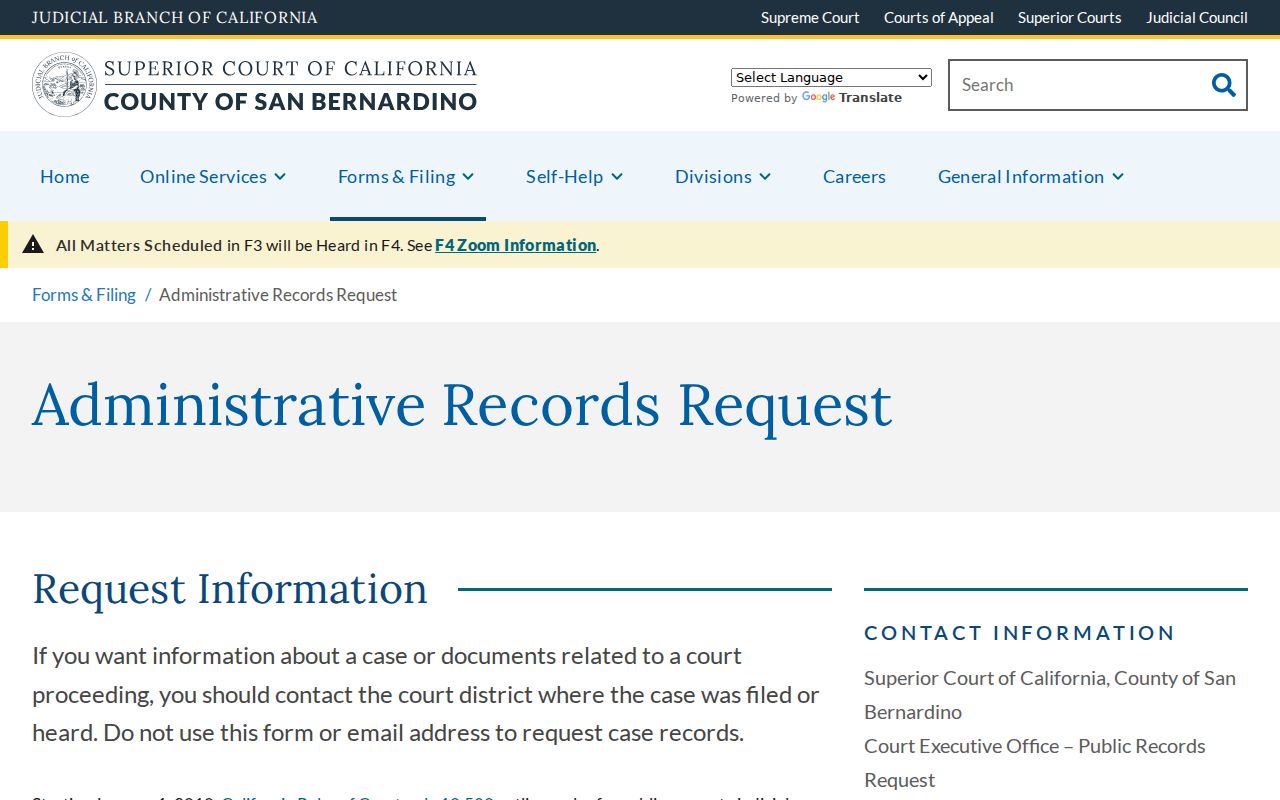
The court's administrative-record guidance makes that distinction explicit, which prevents a records request from being sent to the wrong process.
A public docket result may show case number, title, filing date, category, party names and roles, district, hearings, register of actions, disposition, status, and document-sale links when remote access is allowed. Sealed, juvenile, adoption, dependency, and other restricted matters may show little or nothing. Read the status and filing date before treating a name match as current.
| Case number | The court's identifier for the matter; use it when asking a district clerk for the correct file. |
|---|---|
| Party and role | The named person or entity and the relationship shown in the case, not proof of wrongdoing. |
| Register of actions | A dated list of case events and filings, often shorter than the underlying documents. |
| Disposition or status | The recorded procedural outcome or current case state; read it with the filing date. |
- Docket
- The court's running case record, including filings, events, and status entries.
- Index versus image
- An index points to a record; an image or clerk-held file contains the document text when access permits.
- Certified copy
- A copy issued or sealed by the custodian for an authorized purpose, distinct from free online case information.
Order Highland Vital Records Correctly
San Bernardino County ARC issues county births and deaths and marriages whose licenses were purchased in the county. Recent deaths may take 30-60 days to reach the county channel, so County Public Health can be the earlier contact. The 2026 county fees listed in the research are $34 for a birth, $26 for a death, and $19 for a marriage. CDPH statewide fees are $31, $26, $19, and $18 for birth, death, marriage, and dissolution certificates.
California distinguishes an authorized certified copy from an informational copy. Health and Safety Code sections 103525-103526 limit who may obtain an authorized copy; an informational copy carries an identity-use legend. A confidential marriage record is restricted to the spouses or a court order under Family Code section 509. County-held birth, death, and marriage indices are confidential under Health and Safety Code section 102230, so there is no open county vital-name index to browse.
The ARC vital-records instructions identify the county application route and current ordering choices. County requests can be made by mail, in person, or through an authorized online vendor. A mailed authorized certified-copy application requires notarization; an informational copy does not. The form asks for the event type, names, date and place, relationship or authorized category, signature, and applicant contact details.
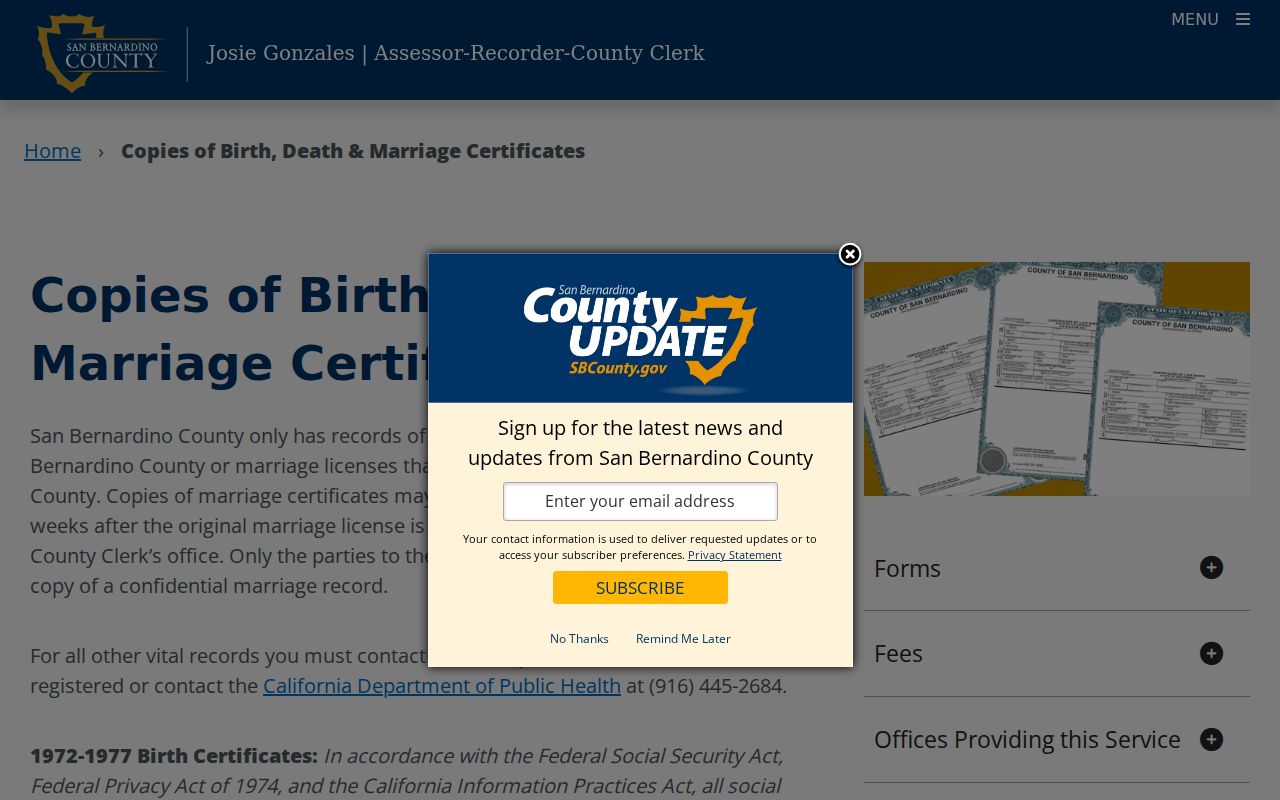
For an older family question, the County Archives holds register-format birth and death records from 1873-1910, marriages from 1853, and probate from 1853-1926. Earlier local marriages route to Los Angeles County. These dates overlap with statewide registration, so choose a custodian by event place and year rather than assuming one index covers everything.
My Voter Status Is Not a Highland Resident List
California's My Voter Status tool is a self-lookup. It asks for first and last name, date of birth, and an identification field when required. It is not a public search for a neighbor, household, or ZIP. The county Registrar of Voters handles qualified voter-file requests under Elections Code section 2194, with permissible-purpose and wet-signature requirements. The County ROV contact is 909-387-8300.
Government Code section 7924.000 keeps street address, phone, email, registration and precinct numbers, prior registration, license or ID number, Social Security number, unique identifier, and signature confidential except as authorized. A qualified file can be geographically tailored for an allowed purpose, but that does not turn it into a public Highland resident directory. A person requesting their own certified voter record or letter may pay the listed $1.50 fee.
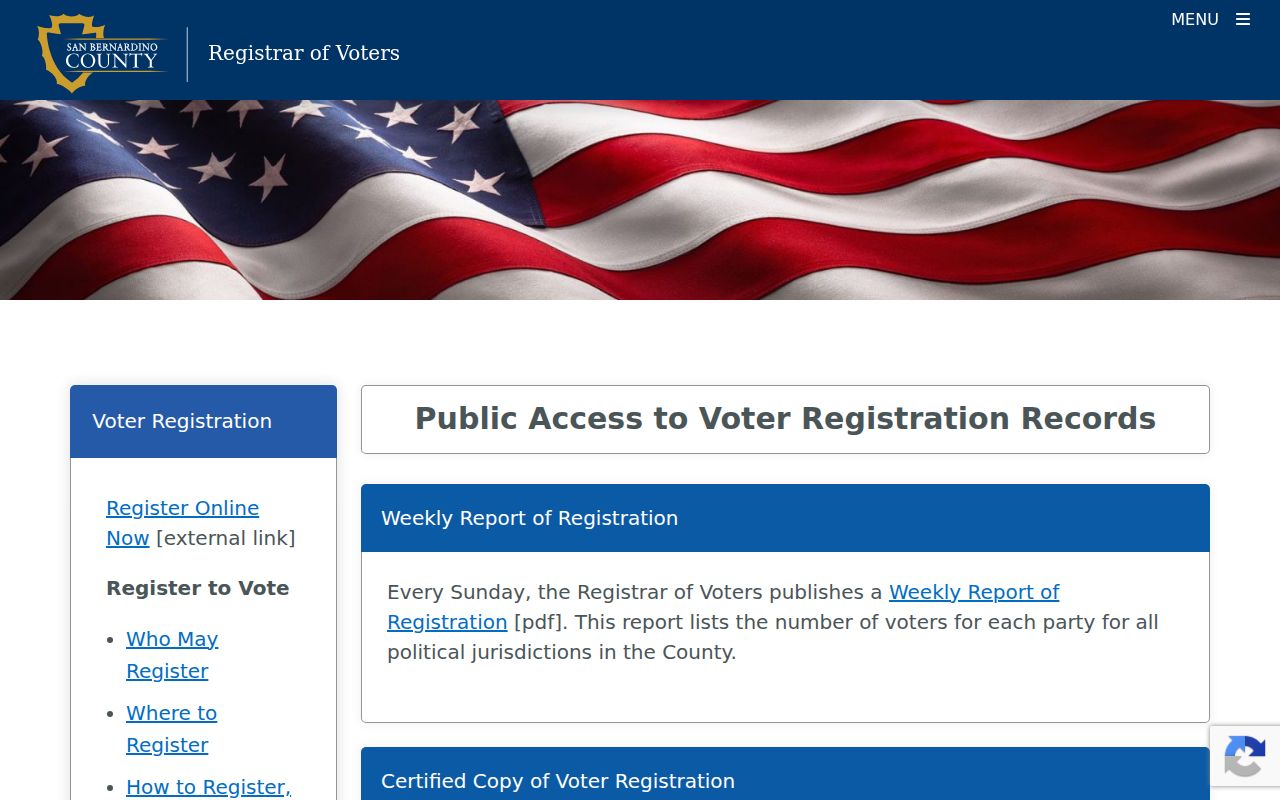
The San Bernardino County voter-record page explains the request boundary and self-record route.
Myth check. A voter-status result is not proof that a person lives at a particular street address, and no result is not proof that the person is absent from Highland.
People enrolled in California's Safe at Home program use a substitute mailing address and confidential forwarding. Do not try to work around that protection by combining public clues to infer the protected address.
Use Highland Probate to Reconnect an Heir
Probate is one of Highland's strongest lawful family-history paths because a filed proceeding can name a decedent, spouse, children, heirs, and addresses in the papers. County Archives holds probate proceedings from 1853-1926. Later probate case information belongs with the Superior Court. Search by decedent name and date, then request the case or archival material through the correct custodian.
An heir search should begin with the death date and a known relationship, not with a broad search for every person with a surname. Compare the petition, orders, and certificates where access permits. An archive description can point to a case number, but the file itself controls what kinship was actually recorded. Probate can reconnect a family branch, yet it does not prove that every person named remained at the listed address.
For an adoptee or birth-parent question, use California's official adoption-information and contact procedures through the responsible state, court, or social-services channels. Adoption records are confidential. For a former classmate, dated yearbooks, libraries, and historical directories are more suitable than voter data.
Check Highland Business Records and Licenses
Some name searches are really affiliation checks. California Secretary of State bizfile searches business entities by name or entity number and can return the entity number, status, formation or registration date, jurisdiction, principal or mailing address, agent for service, and filing-history documents. An agent address can belong to a commercial service, so it is not a home address. County fictitious business names are separate ARC filings.
California Department of Consumer Affairs Search uses board or bureau, license type, license number, business or name, city, state, ZIP, and location fields. Results can show licensee or business name, number and type, status, issue or expiration dates, address of record, and public discipline links. Exact fields vary by board. A contractor, real-estate, medical, nursing, attorney, educator, cosmetology, or alcohol license confirms a credential record, not Highland residence.
The Secretary of State business search shows the entity-search route used for an affiliation check.
Use the filing date, entity status, and named role to separate two people with similar names. If the question concerns a local business license, Highland has no verified public city name register; request an existing, defined record through the City Clerk instead of asking the city to create a list.
The State Controller's unclaimed-property search accepts last name or business name, first name, city, and ZIP. A result can supply an old reported address and holder clue, but it is only a lead; a claim requires proof of identity or ownership.
Defeat a Same-Name Highland Match
Do not merge two people because both appear in San Bernardino County. Require at least two independent anchors. A middle initial plus an APN is stronger than a surname alone. A spouse, event date, occupation, license number, business role, historic address, or case district can supply the second anchor. Keep variant spellings beside the original query, not in place of it.
- Normalize the address in Highland GIS and record the APN, city boundary, and historic locality.
- Compare govPIMS or deed information with the date of the court, certificate, directory, or probate record.
- Search the exact name and likely variants in CAP, ARC, and the relevant state portal.
- Read the party role, record status, and address type. A business, mailing, or agent address is not automatically a residence.
- Stop when the independent anchors conflict. Ask the custodian about procedure rather than requesting protected personal facts by phone.
California's 2026 allowance for specified diacritical marks on vital records makes marked and unmarked searches useful. Hyphenated and unhyphenated forms, maternal and paternal surname order, and initials can matter in Highland's diverse population.
Correct a Highland Record at Source
A commercial compilation can repeat an error, but changing the compilation does not correct the record that created it. Send an ownership or parcel issue to ARC, a docket issue to the Superior Court, a voter issue to the Registrar of Voters or Secretary of State, a vital amendment to ARC or CDPH, and a license issue to the responsible board. Give the custodian the record number, date, and specific field that is wrong.
For a Highland municipal record, the City Clerk's public-record request form asks for an existing record, a description, and a date range. Email delivery is listed as free; paper copies are $0.35 per page, plans $2 per page, and postage may apply. The city generally makes an initial determination within 10 days, subject to a written extension. Agencies need not create a new resident list or answer a research question.
Corrections should preserve the original trail. Note when the request was made, which office responded, and whether the result is an index, image, certified copy, or staff explanation. That distinction makes a later Highland resident lookup more reliable without exposing protected information.
Know When a Highland Resident Lookup Stops
Some trails end for a valid reason. Renters and other household members may never appear in parcel or deed indexes. Pre-1998 court information is limited. Safe at Home protects qualifying participants. Sealed, juvenile, adoption, and confidential records have separate rules. DMV address data is restricted, and voter data is not a public street directory. A blank result needs that source-specific explanation.
Lawful use. Highland resident lookup records are for personal, lawful research. Public availability never authorizes stalking, threats, following, impersonation, or harassment. California Penal Code section 646.9 addresses stalking; stop and use an official safety or reporting channel when a matter involves danger.
When privacy law closes a path, use a narrower public-record request or a family-history institution that can lawfully answer the question. Do not assemble scattered clues to defeat a confidentiality program. A careful stop is part of accurate record work.